

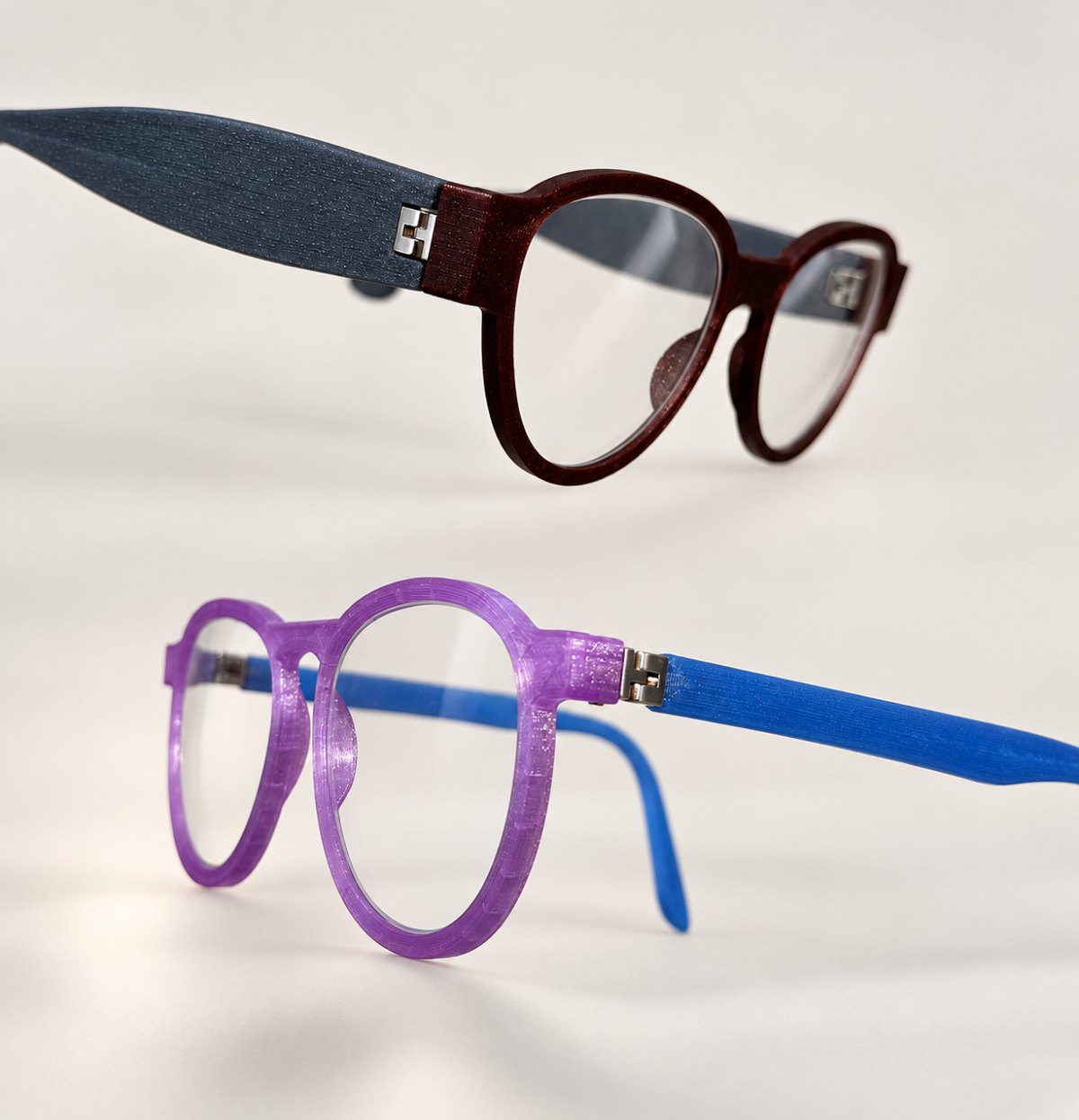
What does a 3D-printed frame look like?
Whatever you decide. That's the whole point: there's no catalog, no mold, no collection to clear. The shape comes from the wearer's face and comes out of the machine in front of them, in store.
minutesfrom measurement to fitting
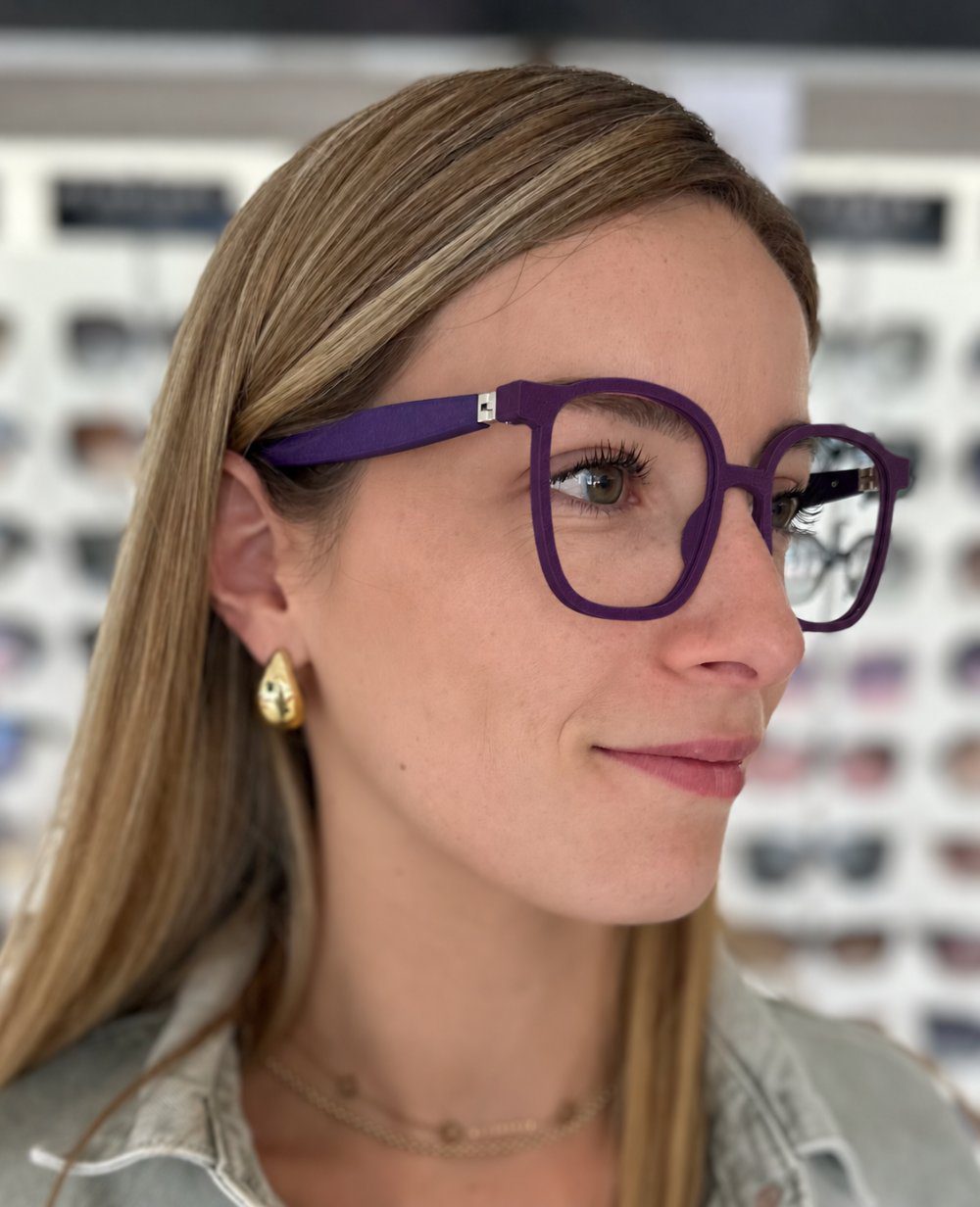
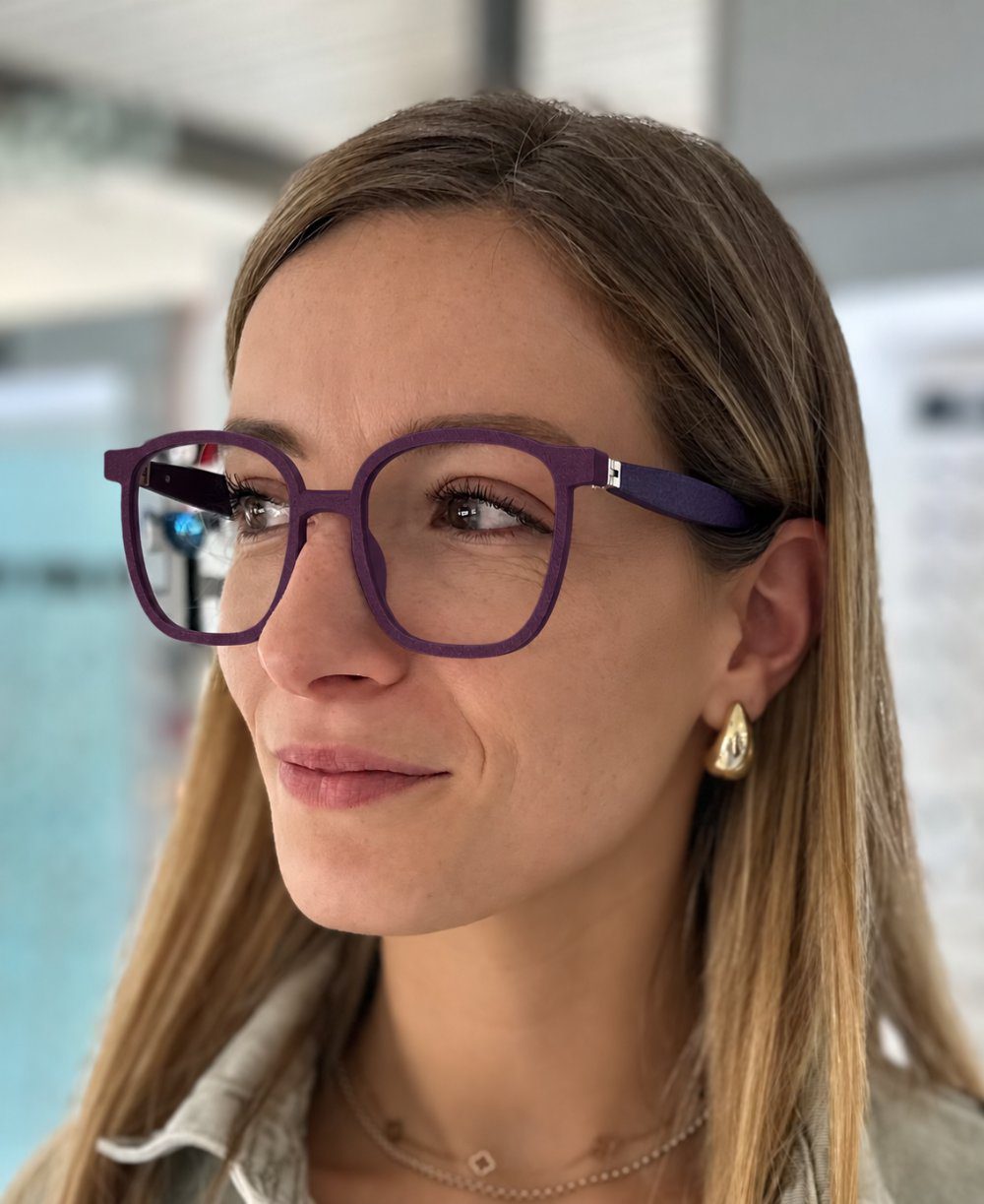
3D-printed frames, worn
Round, square, thin, thick; colorful, understated, two-tone, and more. All made in store, one at a time, for the face that wears them.
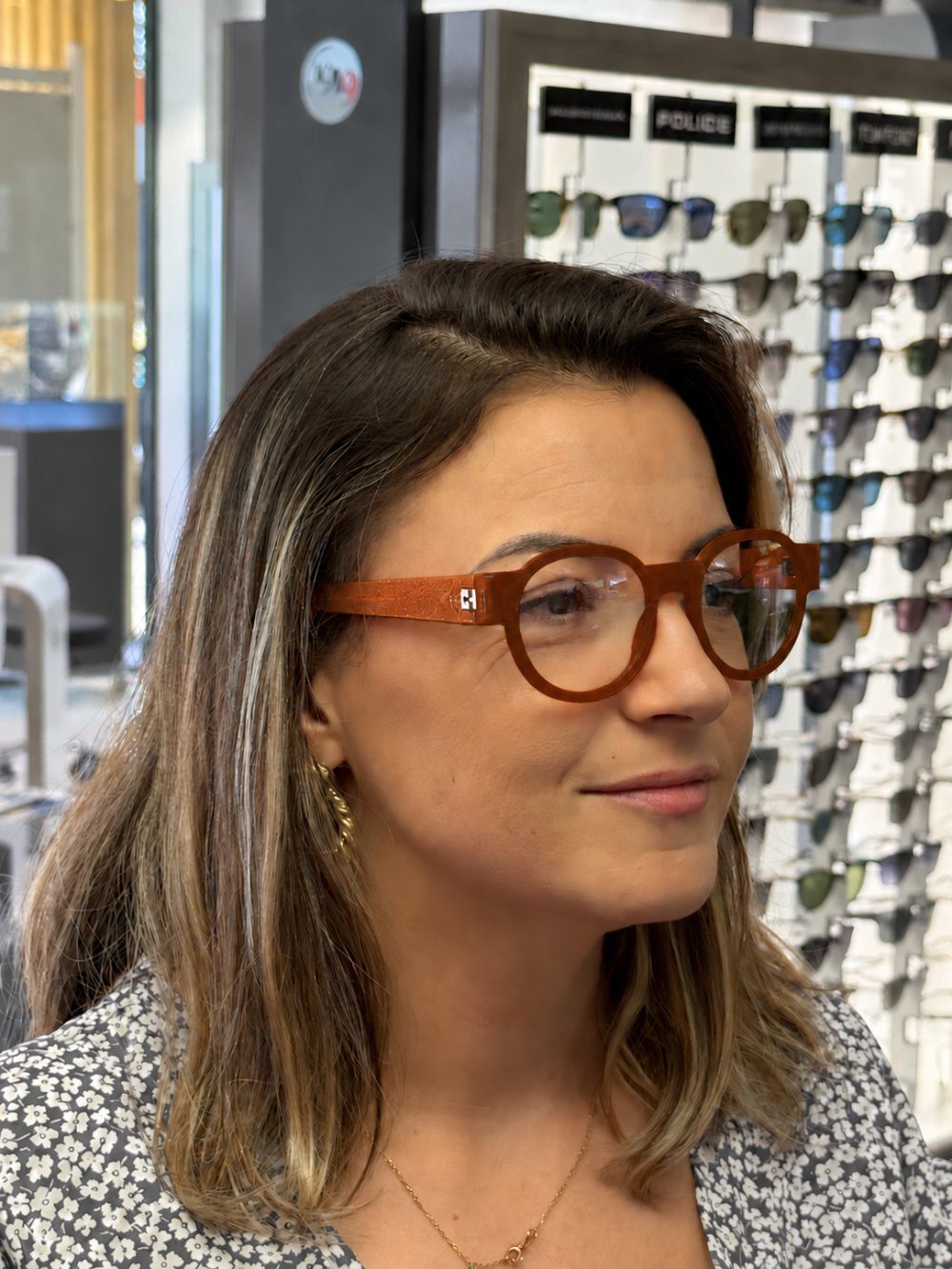

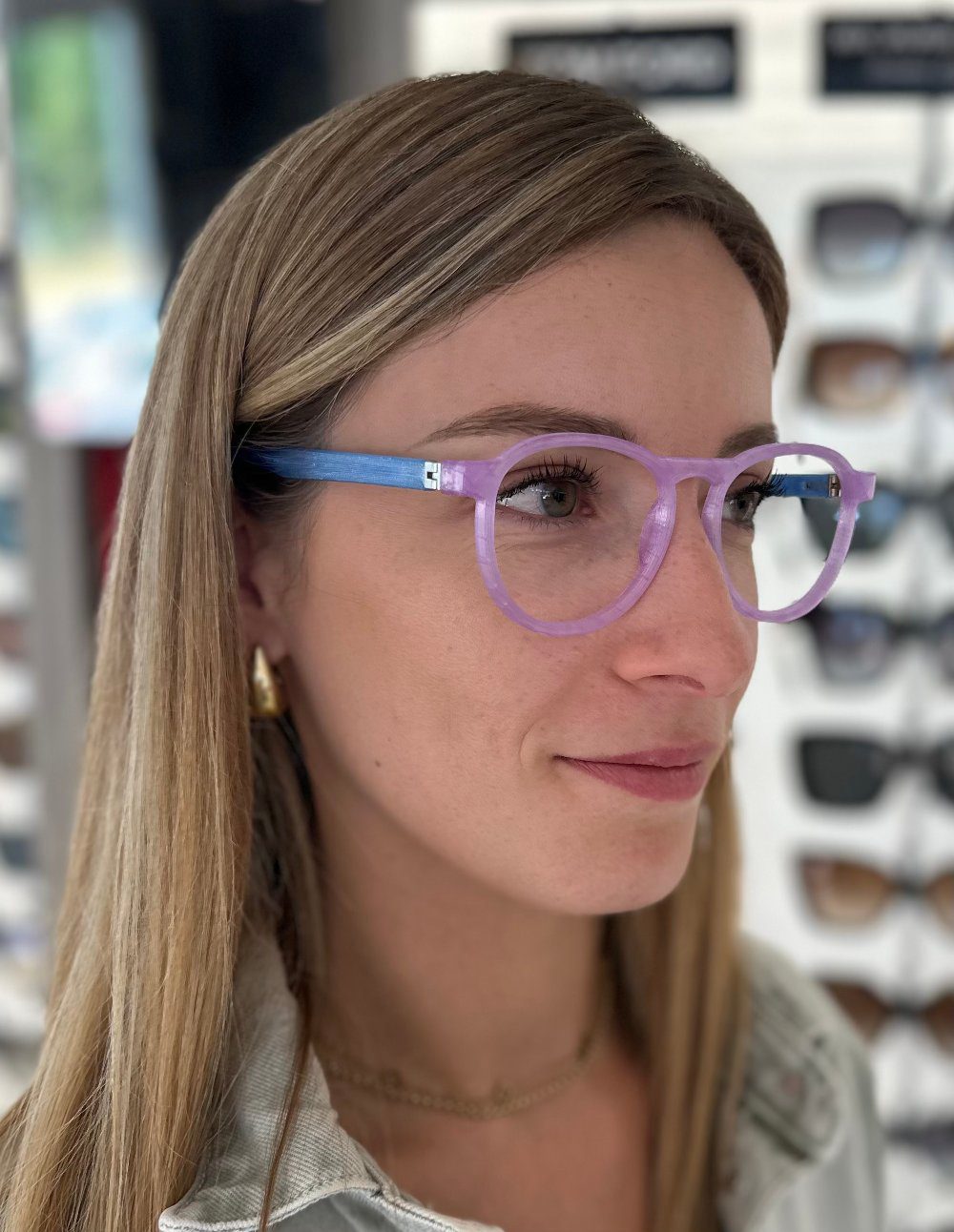
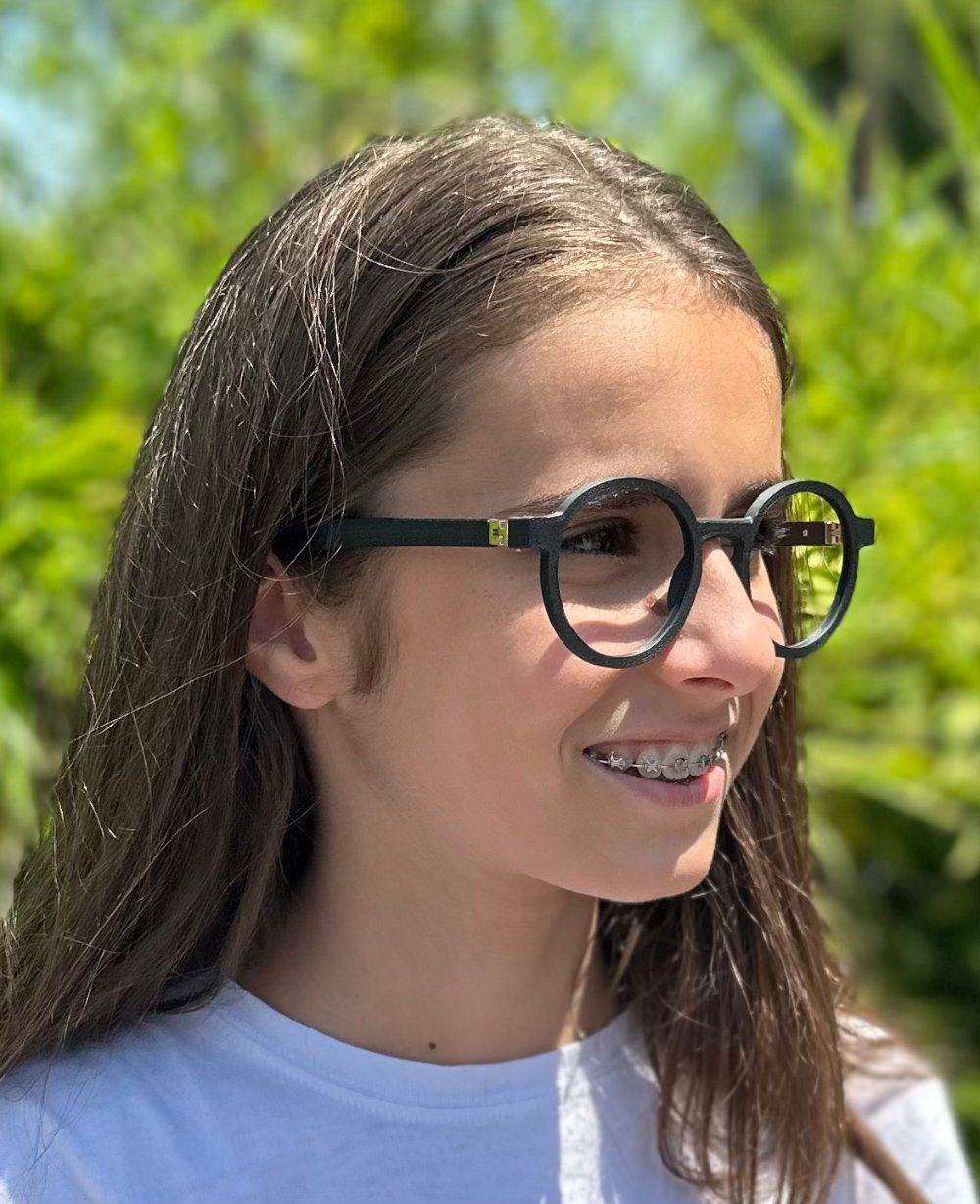

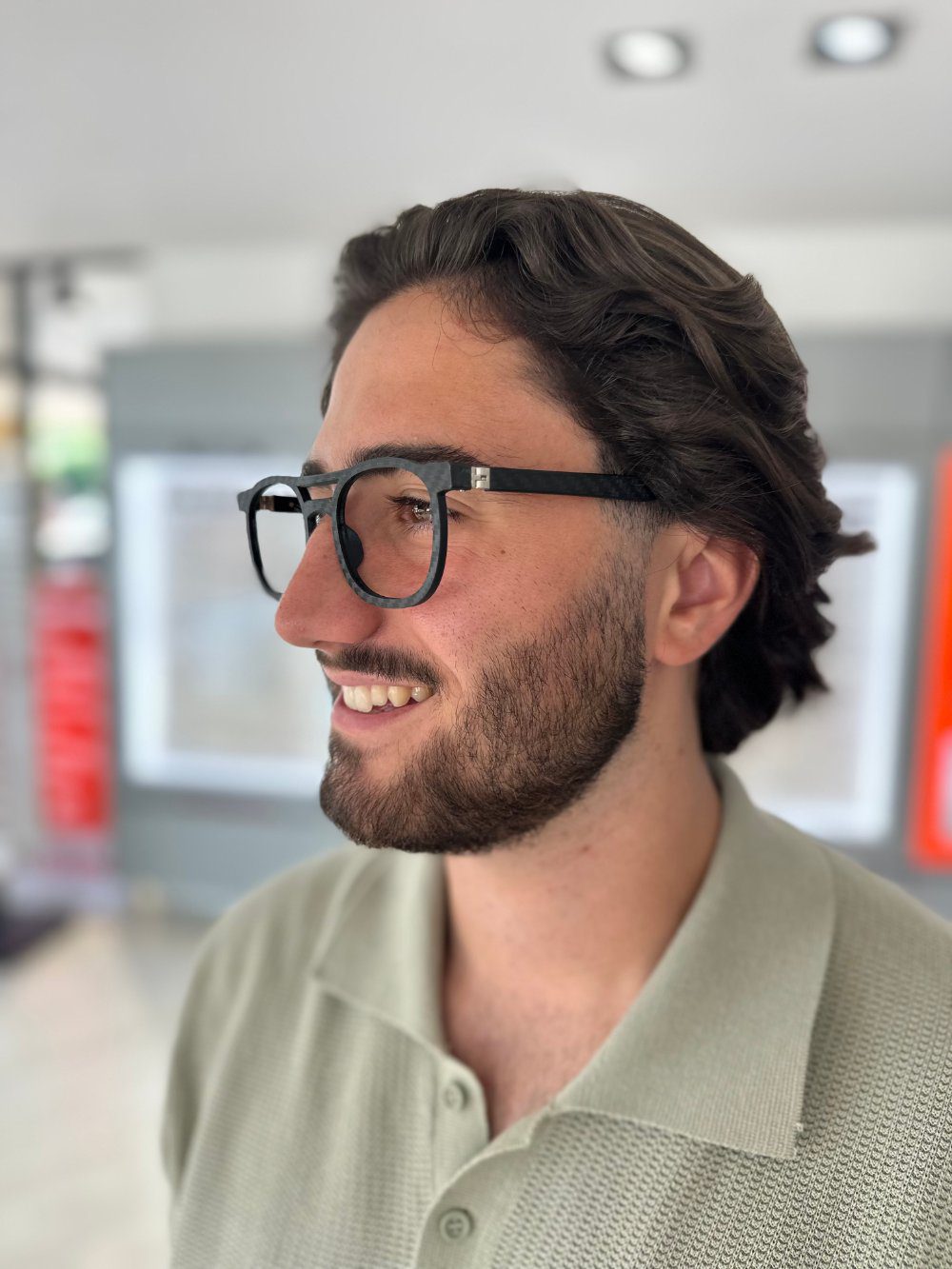

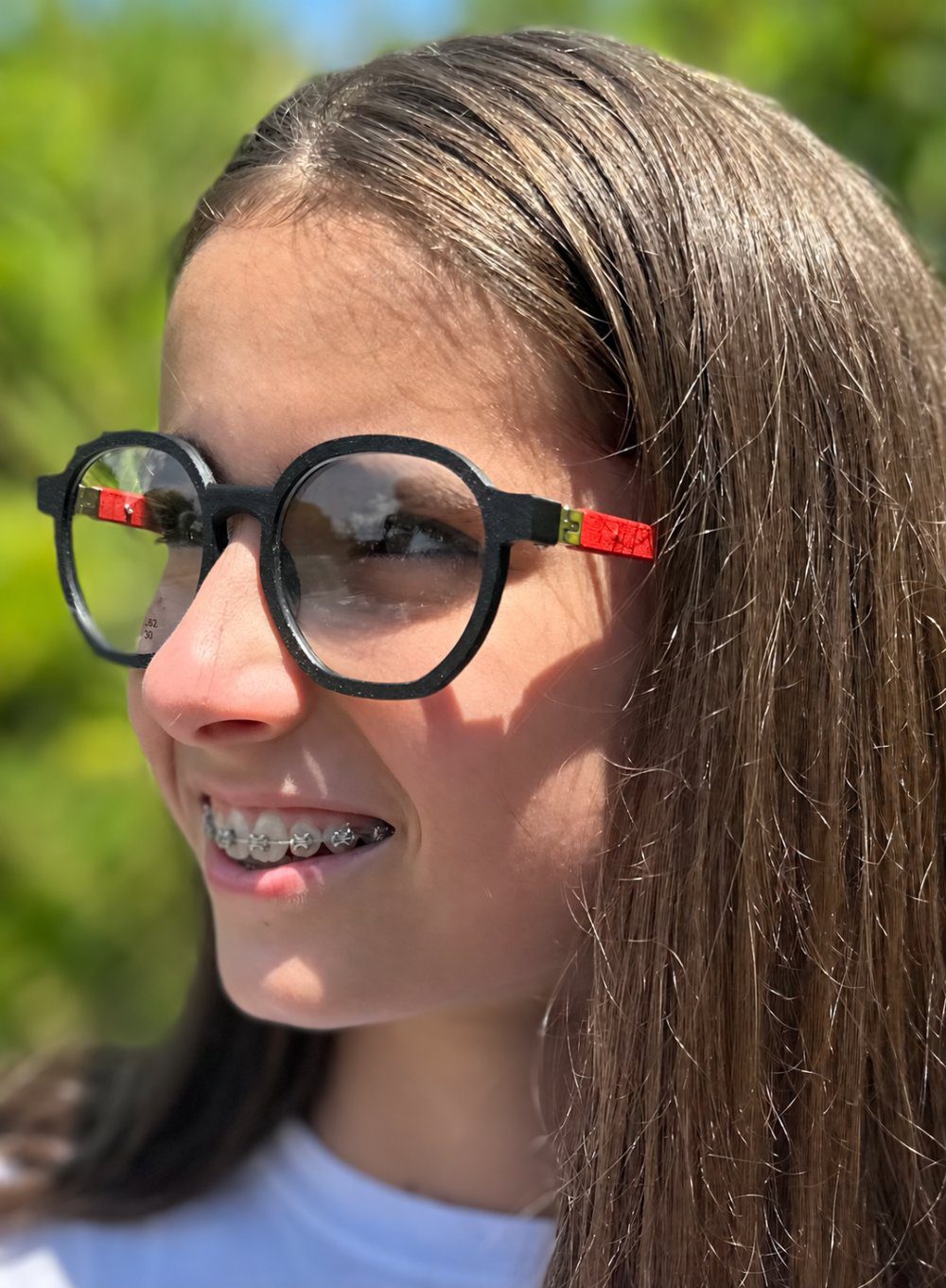

The details that reassure an optician: metal hinges, temples with printed patterns, lenses fitted, controlled thickness. These are workshop frames, worn every day, not demo pieces.
These frames have no brand.
You give them one.
OOframe isn't a collection you resell. It's a manufacturing service: the frame that comes out of your machine carries your store's name, printed in relief inside the temple, and nothing else.
You no longer distribute a supplier's brand on the margin it leaves you. You make your own product, in your own store, under your own name. For an independent optician, it's the first time you can have a brand without a factory. For a retail chain, it's an exclusive collection with no minimum order.
- Store or chain name printed in every frame
- No OOmade mention on the frame
- No stock, no minimum, no unsold items
- A shape can be reproduced identically, or modified for the next wearer
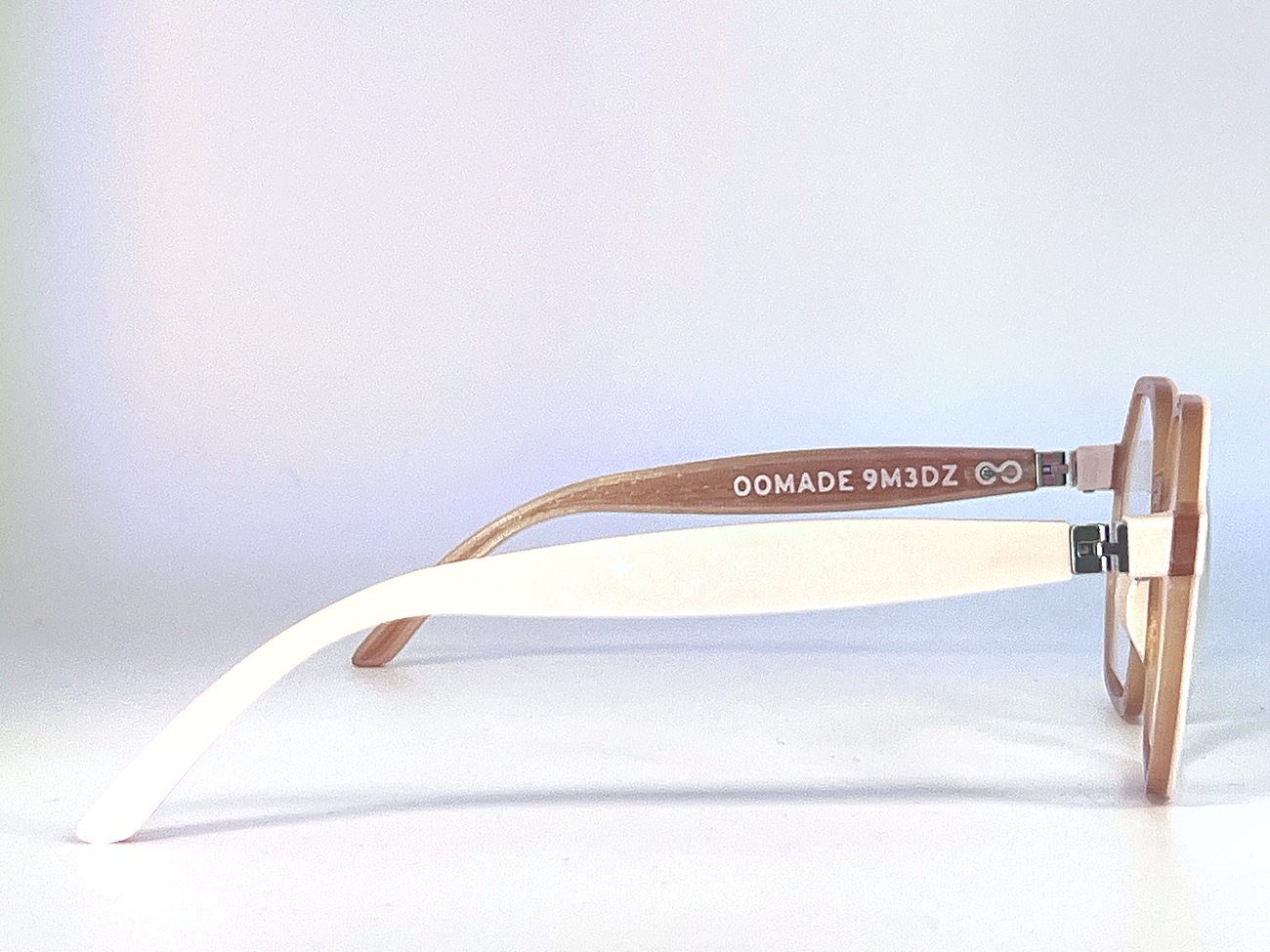
Why this page never says “the OOframe brand”
OOframe is the name of a service, not an eyewear brand. The distinction isn't cosmetic: it describes exactly what you sell, a manufacturing capability, and it saves you from staking a brand claim in an already very crowded market.
The frame starts from the face, not from a size
A catalog frame comes in two or three sizes, designed for an average face. An OOframe frame exists only once, for one person.
 Coming soon
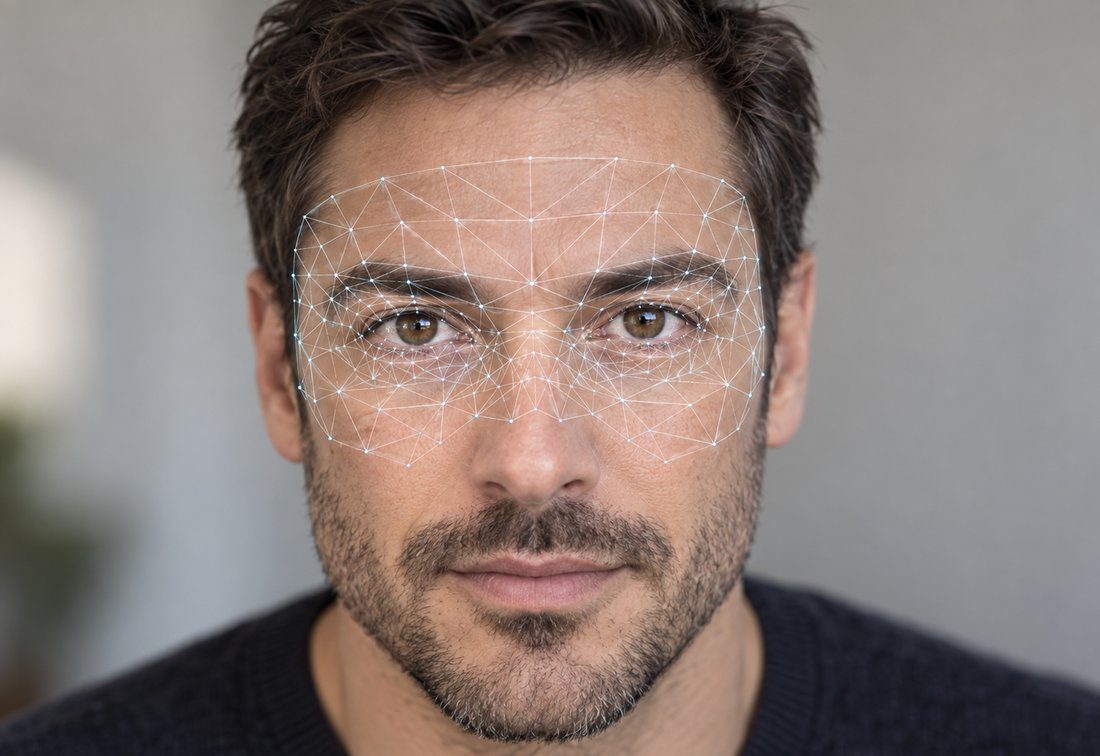
Measure
Pupillary distance, bridge width and height, temple distance, temple length. The measurements you already take, reused to design the frame instead of picking one.
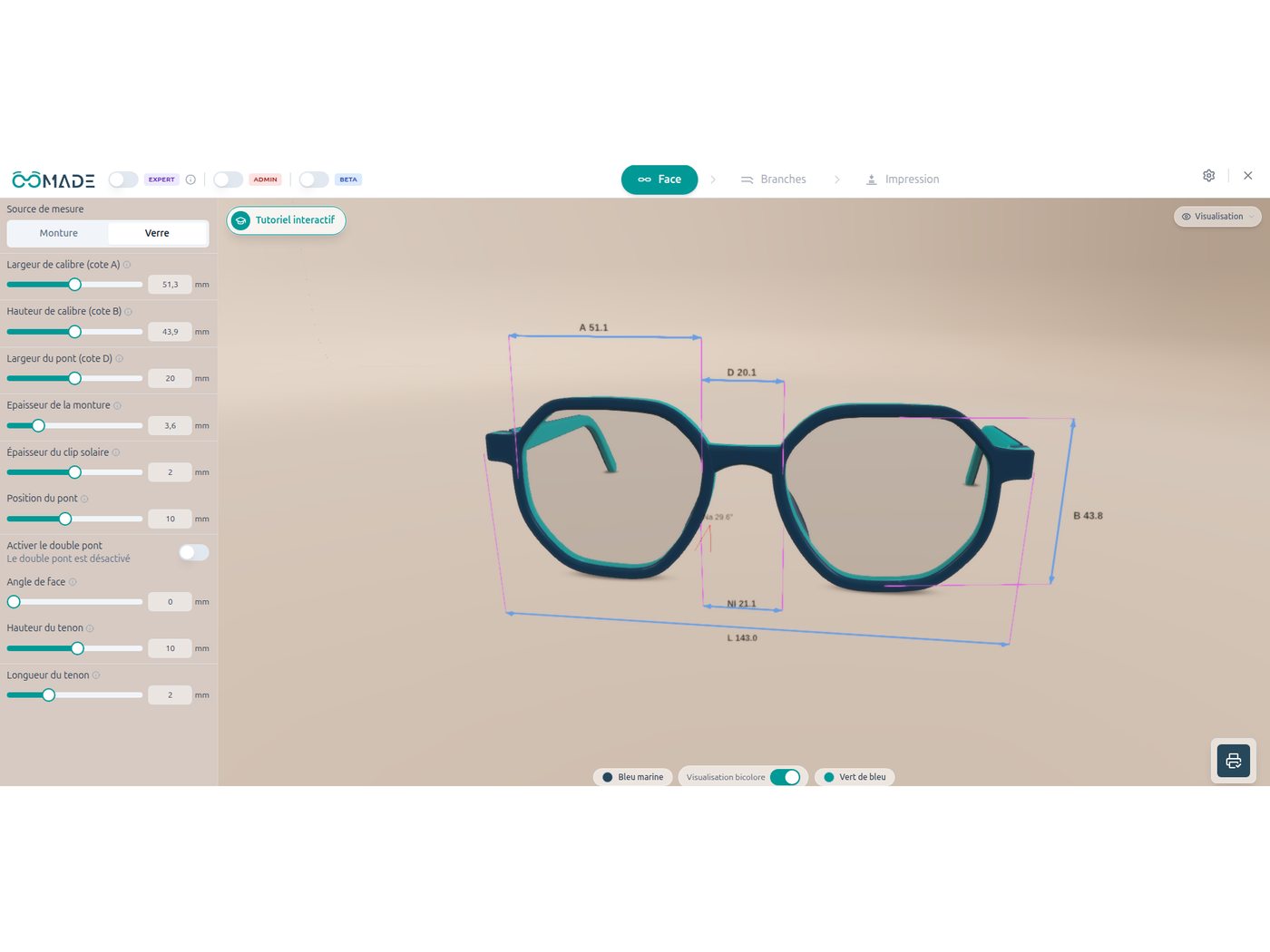
Design
Shape, thickness, color, finish. The customer watches their model evolve on screen, with you, and makes the calls. Advice becomes an act of creation again, not a pick from a display stand.
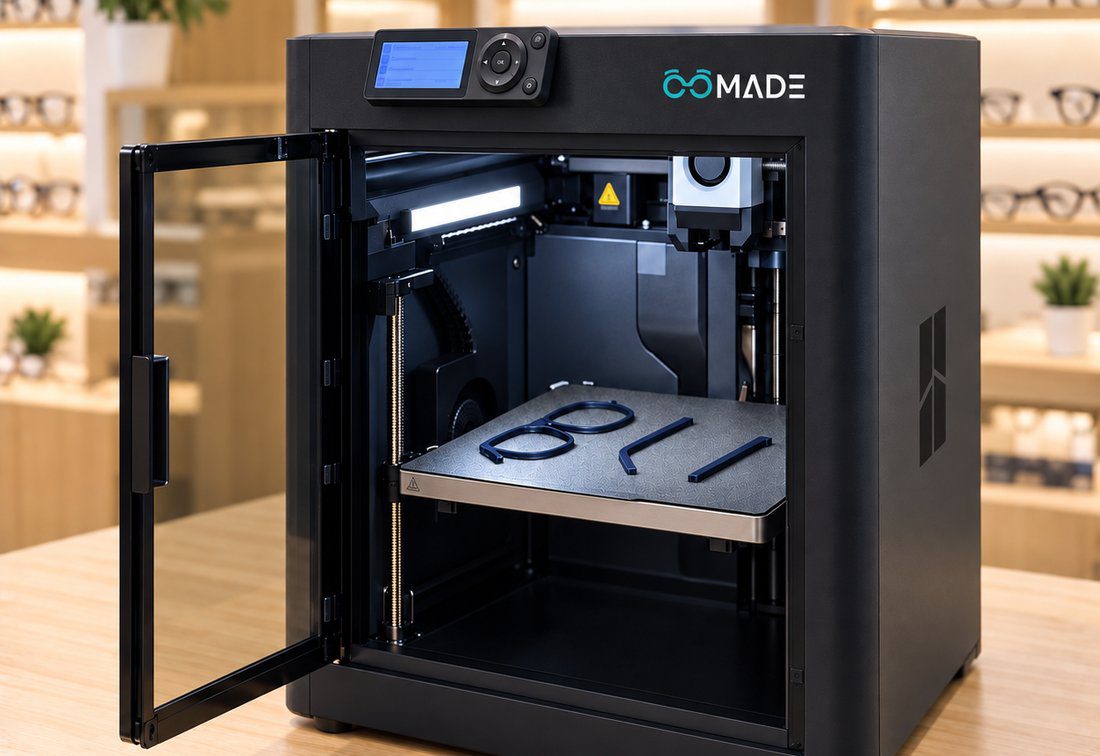
Make
Printing starts in the store. The wearer watches their glasses being made: it's the moment they'll talk about, and one nobody else in their town can offer them.
The face shapes catalogs don't cover
A very narrow or very wide face, a flat nose bridge, a child between two sizes, a strong prescription that calls for a small eye size and precise centration: these are the customers you lose today for lack of a suitable model, or fit with a compromise.
“A great tool for customers with strong prescriptions who can't do without their glasses!”
Visiopolis, Villeneuve-lès-Maguelone
A complete frame final, Standardized
It's the first objection, and a legitimate one. Here are the answers, with no sugarcoating.
- Material
- PETG
- Technical polyester, resistant to impact and deformation. Recyclable.
- Standard
- ISO 12870
- The standard that applies to spectacle frames: mechanical testing, strength, fitness for wear.
- Place of manufacture
- Your store
- No shipping, no dormant stock, no minimum order.
- Manufacturing time
- Several tens of minutes
- For a complete final frame. An OOtrace repair takes about ten minutes.
- Repairability
- Reprinting
- A broken temple is reprinted identically: the serial number points to the original file.
A final frame is not a repair
The ten minutes you see elsewhere on this site refer to OOtrace, the repair service: a new front made from the existing lens, so the wearer leaves with glasses the same day.
A complete final frame, custom-designed and printed temples included, takes longer: several tens of minutes. About the time of an eye exam, or a coffee downtown. The wearer can watch the whole process from start to finish.
A serial number inside the temple, and you provide after-sales service for your own brand.
Every frame made carries its own number, printed inside the temple. That number points to the design file: the exact shape, the exact measurements, the exact color.
Four years later, your customer comes back with a broken temple. You read the number, reprint the part, and they leave with their frame. No supplier reference to track down, no discontinued model, no restocking delay, and no spare-parts inventory to finance for a collection that is yours.
When you sell your own brand,
you handle its after-sales service.
It's the counterpart of white label, and it's what makes it sustainable: an optician can't launch their own collection without the means to repair it. The serial number provides them.
Not to be confused with repairs
OOframe makes new eyewear, not repairs. A final frame is sold as eyewear: it's designed, chosen, invoiced and worn every day.
Emergency repairs are OOtrace's job, a separate service with a different material and a different role. A wearer helped out in about ten minutes is a wearer who will come back to buy complete eyewear; getting a repair isn't buying eyewear.
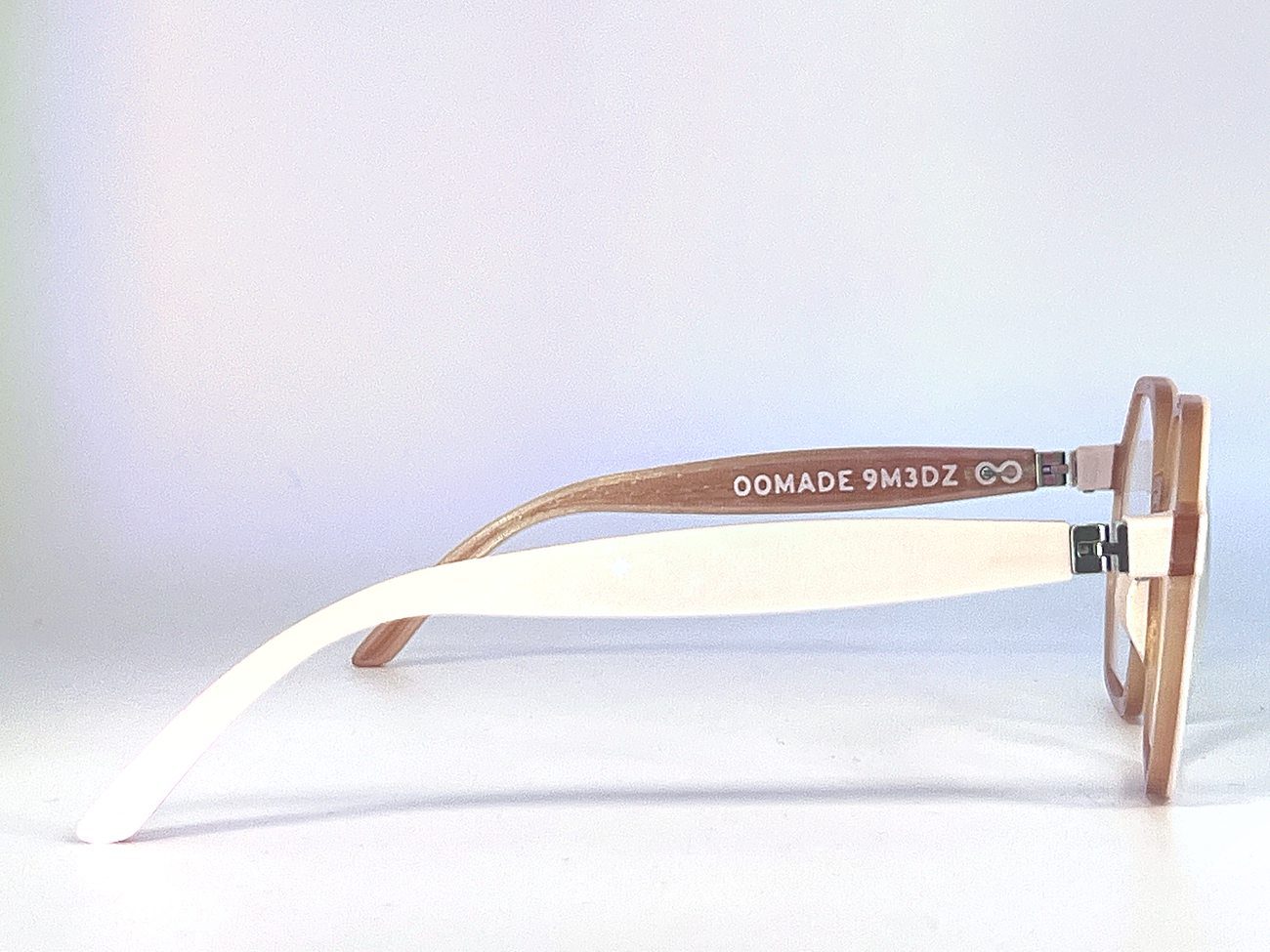
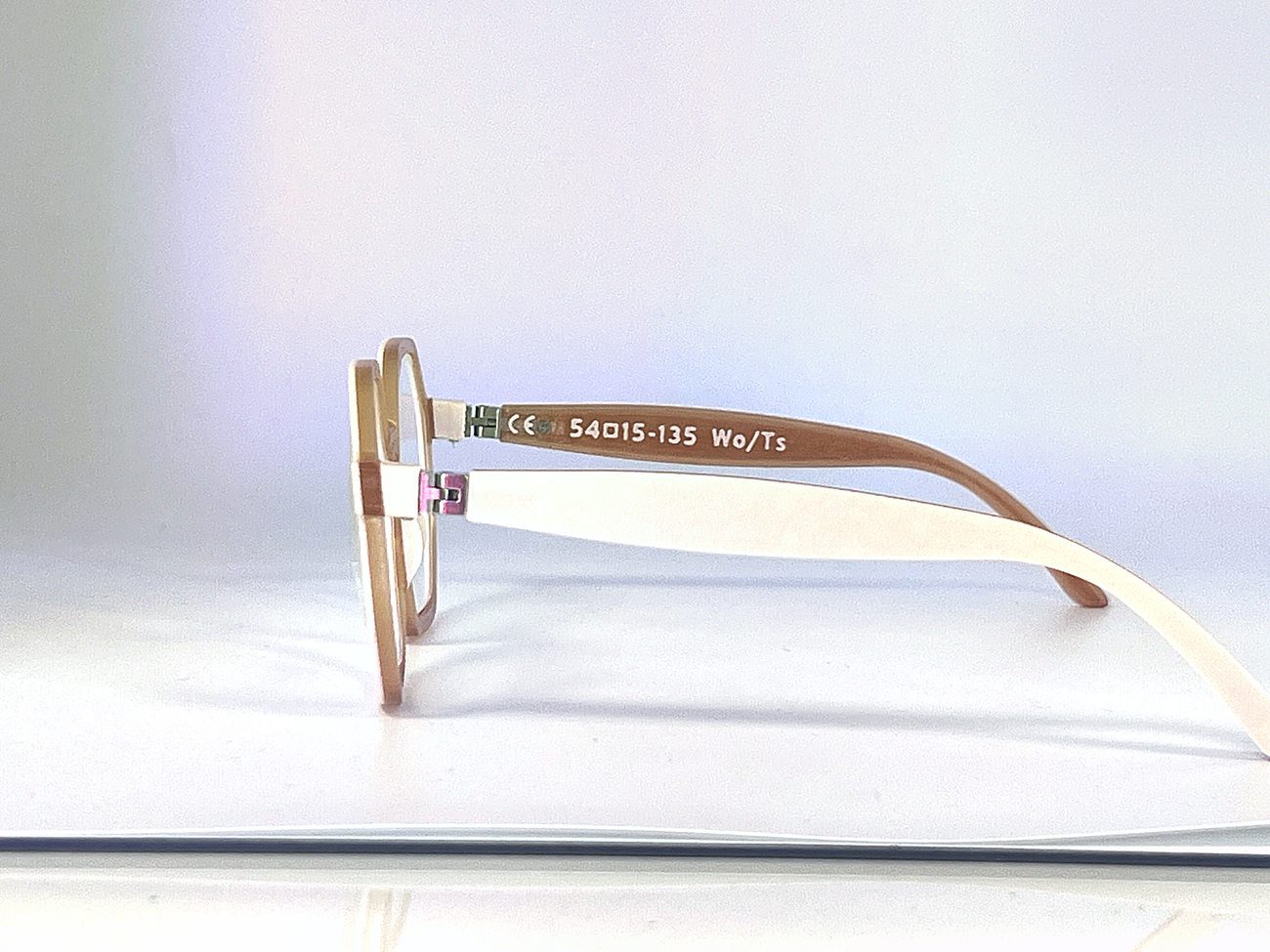
On the left, the serial number: it's all you need to recall the frame's exact geometry, years later. On the right, the standard marking, eye size, bridge and temple length, printed into the material during manufacturing like on any frame on the market.
A useful, local, repairable frame
It's not a feel-good extra added after the fact. It's the mechanical consequence of making where you sell.

Made in the store
No manufacturing on the other side of the world, no freight, no restocking. The frame travels three meters from the machine to the counter.
PETG, recyclable
A recyclable technical polyester, ISO 12870-certified for everyday wear. No acetate to cut, no sheet offcuts: we print only the material we use. PLA is reserved for OOtrace repair frames, where short life is intended.
No unsold items
A frame is only made once it's sold. No collection to clear, no markdowns, no end-of-line stock headed for the dumpster.
Repairable, not replaceable
Thanks to the serial number, a broken part is reprinted instead of forcing a whole new purchase. Repairability isn't an option: it's built into the process.
And it's a sales argument, not just a value
The retail chains and health insurers we work with have sustainability commitments to document. “Frame made on site, with no shipping, from recyclable material, identically repairable throughout its life” is a sentence a purchasing department can add to its own file. Your customers understand it without any explanation.
You no longer resell a margin. You make a product.
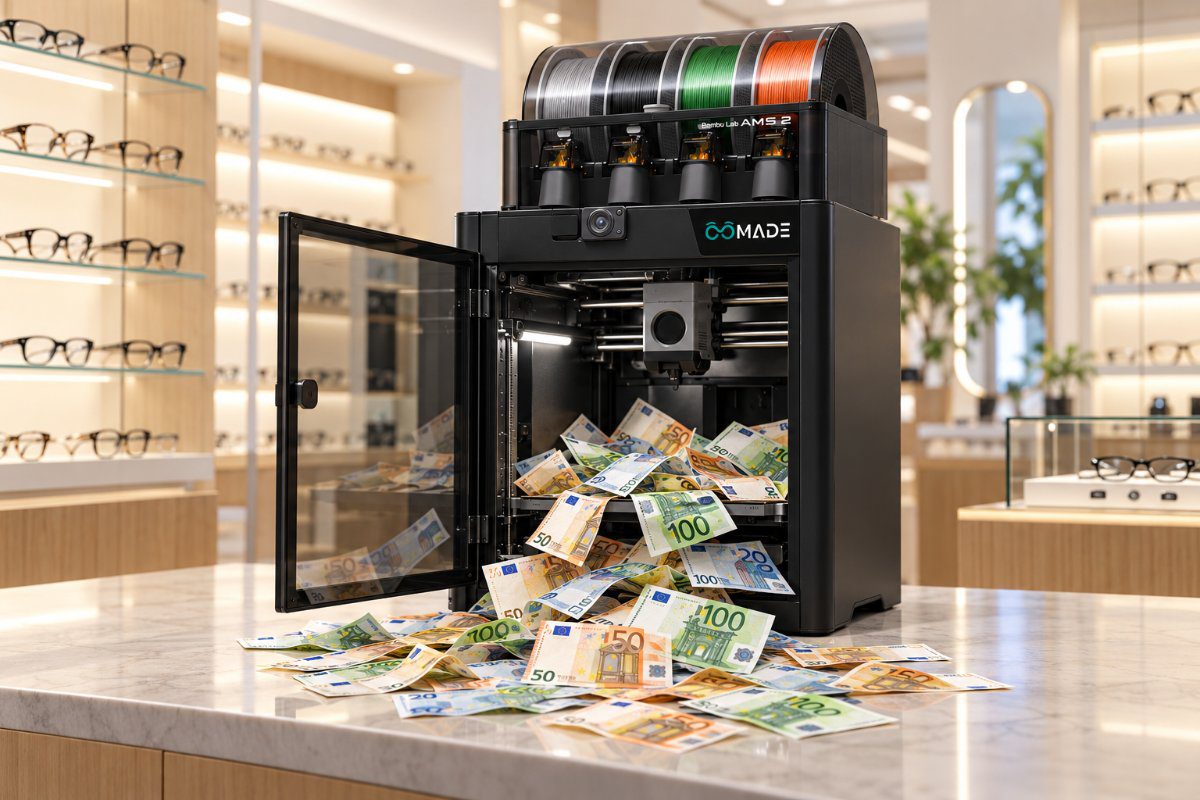
This is where the machine's return on investment is made, and nowhere else. The repair builds loyalty; the final frame brings in revenue.
A frame bought wholesale is resold on the margin the supplier leaves you, on a model the store across the street can order too. A frame you make has no purchase cost, no tied-up stock, and no competitor selling it. And it carries your name.
of wearers helped out in about ten minutes come back to order a final frame. After-sales isn't the product: it's how you acquire customers for the product.
Krys Strasbourg-Bourgeois
“Personally, I enjoy making a 3D frame much more than digging through a big box full of temples, and it's more rewarding too.”KrysStrasbourg · Bourgeois
“It's an offer that sets us apart from the competition. Having the printer in the window, showing off a new technology, gets people asking questions.”KrysRodez · Gambetta
After-sales becomes an appointment
A frame you can reprint identically isn't a warranty cost: it brings the wearer back to your store, serial number in hand, every time something happens. It's a chance to see them again, not a dispute to handle.
And it's a selling point at the counter: you're the only one in town who can promise a frame will never disappear from your catalog.
What we're asked most often
Is a 3D-printed frame strong?
It's made of PETG, a technical polyester chosen for its resistance to impact and deformation, and it meets ISO 12870, the standard for spectacle frames. It's not the same material as a decorative object from a desktop printer.
And if it breaks, the frame is reprinted identically: the wearer's file is kept.
Does it really look like glasses?
Look at the photos above and judge for yourself. Shape, thickness and finish are chosen at the design stage: an OOframe frame can be thin and discreet or thick and bold. What sets it apart isn't how it looks, it's that it was designed for one face only.
Can my usual lenses be fitted to it?
Yes. The frame is designed around the wearer's eye size and centration, so around the lenses, not the other way round. That's actually one of the process's advantages for strong prescriptions, where frame choice is usually limited.
How long does it take to make one?
Several tens of minutes for a complete final frame, temples included. The ten minutes mentioned elsewhere on this site refer to OOtrace, the repair built from an existing lens. It's not the same service.
In practice, the wearer can watch the whole manufacturing process, or come back after their eye exam.
If I break my frame in two years, what happens?
Every frame carries a serial number printed inside the temple. That number points to the design file: your optician reprints it identically, with the same measurements and the same color.
It's also a guarantee that your lenses, the expensive, prescribed part of your eyewear, stay usable whatever happens to the frame.
What is the price of an OOframe frame?
Pricing depends on your volume and setup. It's presented during the demo, with a return-on-investment calculation tailored to your store.
Is OOframe also used for repairs?
No, and the distinction matters. OOframe makes new eyewear: a final frame, custom-designed, sold and worn every day.
Emergency repair is a separate service, OOtrace, with a different material and a different purpose: letting the wearer see today, while a new pair is made. The two complement each other, but neither replaces the other.
Does the frame bear the name OOmade?
No. It carries yours. OOframe is a white-label manufacturing service: the inside inscription shows the name of your store or chain, and no OOmade mention appears on the finished product.
Do I need training to use it?
Onboarding is supported and included in the offer. It covers the app and lens fitting: there's no technical 3D-printing training to take, because none is needed. The machine and the generator handle the technical side; the rest is your craft.
Come and watch a frame being designed, then coming out of the machine.
It's the only demo that counts. In your store, or at a trade show where we exhibit.