

Your customer no longer picks a shape from a virtual try-on. They try it on.
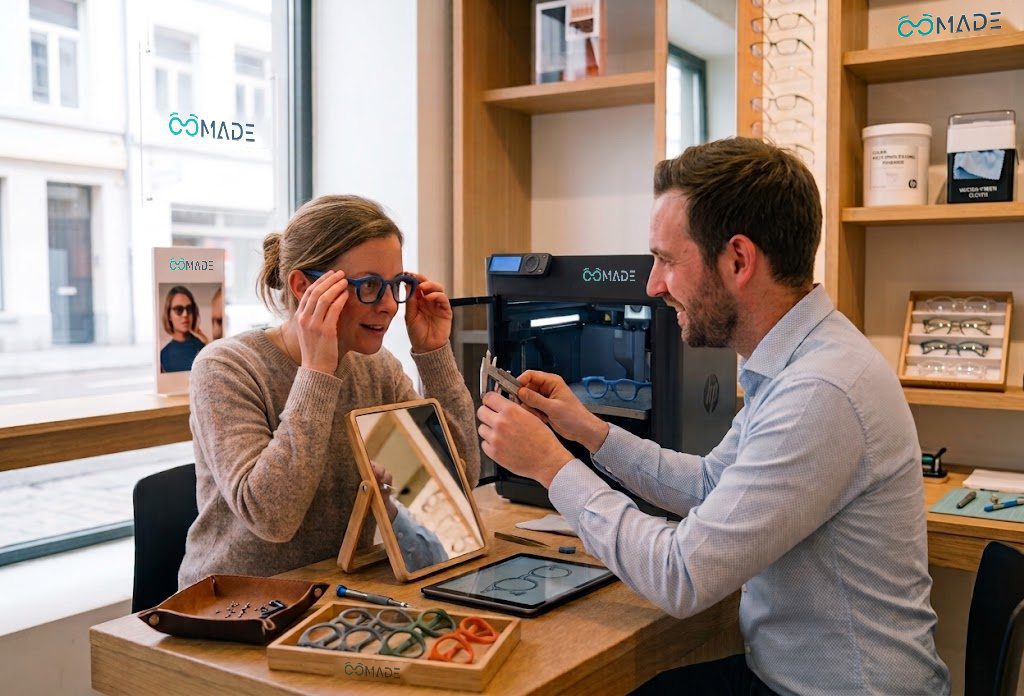
During the sale, you print the shape you're suggesting. The customer puts it on, looks in the mirror and approves it on the spot. The order only goes to your made-to-measure supplier once the geometry is approved, and you no longer have to ask your prospect to come back for a fitting.
The prototype already exists. It's just made in the wrong place.
An optician who does made-to-measure knows prototypes well: they're standard practice in the trade. But they're made at the supplier's, tens or hundreds of kilometers from the store.
You have to request it, wait for it to be made, wait for it to be delivered, and meanwhile the only object that can remove the customer's doubt is in transit. The fitting no longer depends on you: it depends on a supplier and a courier.
The result: you have to get the customer to come back. And that's precisely where the conversion rate of a made-to-measure quote collapses: not on price, not on shape, but simply because a second appointment is needed to try it on.
The real objection
Customers don't come back because you ask them to: they come back if they have time. In between there are their hours, their job, their vacations. An appointment that has to be rebooked is an appointment that may never be rebooked.
During the sale
OOproto doesn't do away with the prototype: it brings its production back to your store. The same object, at the moment of the conversation that created it. The machine works while you carry on with the consultation.
The same journey, with the decision moved to the right place.
Nothing disappears from the made-to-measure process: ordering, manufacturing and pickup stay the same. Only the fitting changes place.
Simplified diagram. The exact process depends on your made-to-measure supplier.
Six reasons why a customized quote is a good idea does not sign.
None of them is about the product. They all stem from one fact: the prototype isn't made where the sale happens.
The appointment to secure
It's the weakest link in the whole process, and the one nobody counts. The customer has to find a slot and come back a second time, for a fitting whose importance they don't see. Many never rebook: the quote isn't lost, it just fades away.
Momentum that fades
A made-to-measure sale runs on enthusiasm, that of a customer who's just been offered something that exists for no one else. Three weeks later, all that's left of that conversation is the amount on the quote.
Competition gets time to step in
While the prototype travels, the customer walks past other store windows, browses online, asks around. You created the desire; you give others time to capture it.
The loop nobody dares to restart
If the prototype isn't right, you need another one: new production, new delivery, third visit. Nobody dares. So a shape that “will do” gets approved, and made-to-measure loses exactly what the customer chose it for.
The cost already incurred
The prototype was made and shipped before the decision. If the sale doesn't close, someone pays: the craftsman, you, or both. It's a cost that's never recovered.
A store with no control
The fitting, the decisive moment of the sale, depends on a workshop and a courier. You carry the customer relationship, the advice and the commercial risk, without controlling the schedule.
Iteration becomes free again
It's the least visible and most important consequence. When a prototype costs a trip, a production run and a delivery, you make one and settle for it. When it costs a few grams and the length of a consultation, you make two or three, until the shape is right.
Made-to-measure stops being a gamble and becomes a fine-tuning again.
Between the quote and the prototype, the customer can change their mind… or their optician
OOmade removes this period of uncertainty: the prototype is made and tried on during the appointment, and the customer approves the shape and the quote right away.
A customer who leaves to think it over doesn't tell you they'll compare elsewhere: they simply don't come back. What gets decided during the appointment isn't lost in silence.
Six situations where the prototype makes the sale
These aren't edge cases. They're the consultations that today end with “I'll think about it”.
The shape no display carries
A very narrow, very wide or clearly asymmetrical face, a child, a strong prescription. The collection stops at two sizes; faces don't. You no longer have customers try on “roughly the right size” and ask them to imagine the rest.
Fitting height for progressives
A rim that's too shallow squeezes the progressive corridor, and nobody notices until glazing. The prototype lets you check the usable height on the real face, with the gaze in its natural position, before the frame is made.
The model they loved that no longer exists
They come in with a frame discontinued years ago, sometimes broken. You capture the shape, print it, and they're wearing it again right away. The conversation about how to remake it starts afterwards, and it starts well.
Modifying an existing model
The same design, but a wider bridge, a longer temple, a deeper rim. Impossible to picture from a catalog, obvious on the nose. That's where made-to-measure stops being a word and becomes an object.
The intuition you had nothing to back up
You can see the shape that would suit this face, and you have no way to show it. A prototype turns your optician's eye into a tangible argument. It's the only trade where expertise stays invisible until the product exists.
The conversation that leads to a second pair
A customer has worn the same shape for ten years because they've never tried anything else. A prototype costs too little to hesitate over printing a second one, and that's often the one that sells.
A printer never starts the press without a signed proof.
Made-to-measure eyewear does. You order a one-off piece, non-returnable and non-resellable, on the strength of a drawing and a conversation. It's the only craft where you make before you show.
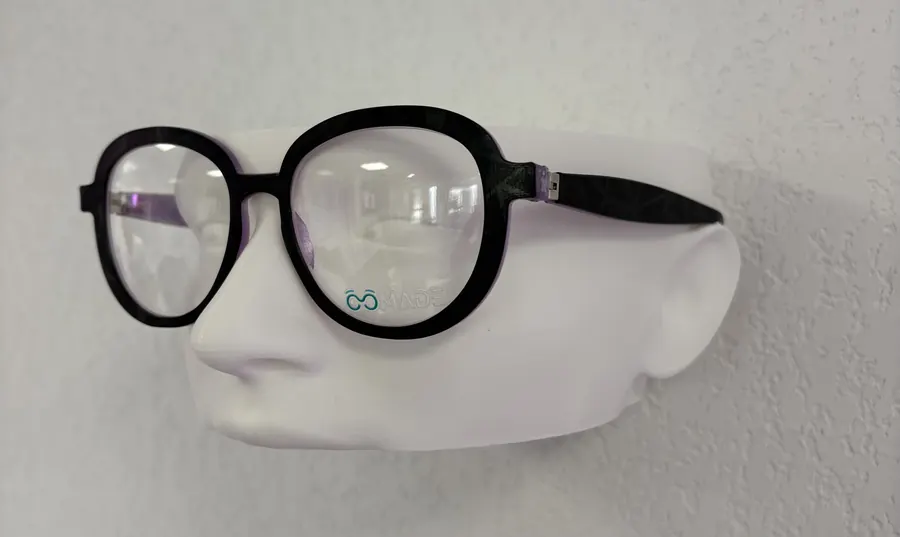
The OOproto prototype is that sign-off proof: the customer has worn the shape, seen it on their face, and said yes. What goes into production is no longer an interpretation, it's an approved geometry. And if the frame still comes back different from what was approved, the discussion with the supplier no longer relies on memories.
What an OOproto prototype is, and what it isn't
A service that overpromises backfires on whoever sells it. Here's the limit, stated clearly.
- What it validates
- A shape, dimensions, a volume
- Front width, bridge, rim height, temple length, the overall look on the face. Everything you judge in a mirror.
- What it doesn't validate
- The final material and color
- A printed prototype doesn't render acetate, metal or laminate. It answers “does this shape suit me?”, not “in what material?”.
- What it contains
- No lenses
- The prototype is for seeing the frame, not for seeing through. Lenses remain a matter for glazing, once the final frame has arrived.
- Time
- About ten minutes
- The temples are printed in advance and reusable: only the front is made during the appointment, as with an OOtrace repair.
- The material
- Bio-based PLA
- Recyclable and deliberately short-lived: the prototype never replaces the frame it helped sell.
- What happens to it
- A saved file
- The approved geometry is saved like any OOmade frame. It can be reprinted identically, modified, or made as a final frame.
What if the customer prefers the prototype they've just tried on?
It'll happen more often than you think. A customer who finally wears a shape made for their face doesn't happily go back to what they were offered before.
At that point, there's nothing to order from anyone: the same geometry goes into final production, in ISO 12870-certified PETG, under your own brand. That's OOframe, and you've just sold it without even pitching it.
That's why OOproto is the easiest service to bring into a store that already works with other suppliers: it doesn't ask you to give anything up, and it opens the door to the rest of the ecosystem through use rather than sales talk.
What opticians ask first
Won't this drive away my made-to-measure supplier?
The opposite happens. A made-to-measure supplier suffers from remakes and refusals as much as the optician does: a rejected one-off piece can't be resold to anyone. An order approved on the face before production is an order that doesn't come back.
OOproto doesn't design for them and doesn't manufacture for them. It removes the blind spot between your advice and their production.
I do semi-custom, not original design. Does this apply to me?
Even more so, because that's where the paradox is most visible: customers are asked to choose from tens of thousands of combinations (shapes, materials, colors, finishes) without ever being given anything to hold. A configurator shows them an image, not an object.
A printed prototype settles the question of shape and size during the appointment. The rest of the choice, material and color, becomes a pleasure again instead of a gamble.
I already do fully original design. What does this change for me?
The order of things, and the number of back-and-forths. The prototype remains a step in your process, between the drawing and the fitting on the face. It just stops being a step that's outsourced, shipped and scheduled.
Above all, it stops being one of a kind: you can print two, compare two curves or two rim heights on the face, and then send only the chosen geometry to production.
Can I invoice the prototype?
It's up to you. Two approaches work: a free prototype, fully embracing its role as a sales tool; or a prototype that's charged and then deducted from the order, which commits the customer and filters out try-ons that go nowhere.
Do you need a special measurement?
No. It's the same shape capture as for an OOframe frame: you start from a tracing and a morphology, and the 3D generator calculates the full geometry on its own. You have nothing to model, and you don't need any drawing software.
How long does the customer have to wait?
About ten minutes, the length of a consultation: printing starts while you continue the eye exam or the advice.
The temples are printed in advance and reused from one try-on to the next; only the front is made on the spot. That's what makes the try-on possible during the appointment rather than after it.
And what if the delivered frame does not match the approved prototype?
Then you have something you never had before: a physical reference and a dated file of what was approved. The discussion with the supplier no longer rests on two diverging memories.
What happens to the prototype after approval?
Either it goes home with the customer, who has rarely seen an object made for them in about ten minutes: it's a great word-of-mouth starter. Or it joins the collection bin: OOmade printing material is recyclable, and nothing that comes out of the machine is designed to end up as waste.
Bring us a difficult face.
It's the best possible demo: a shape that doesn't exist in any collection, printed and worn while we talk. At a trade show where we exhibit, or right in your store.